
SEARCH WHAT YOU WANT
MFI Testing for Masterbatch: How It's Measured and Why It Predicts Dispersion
Time:2026-10-23
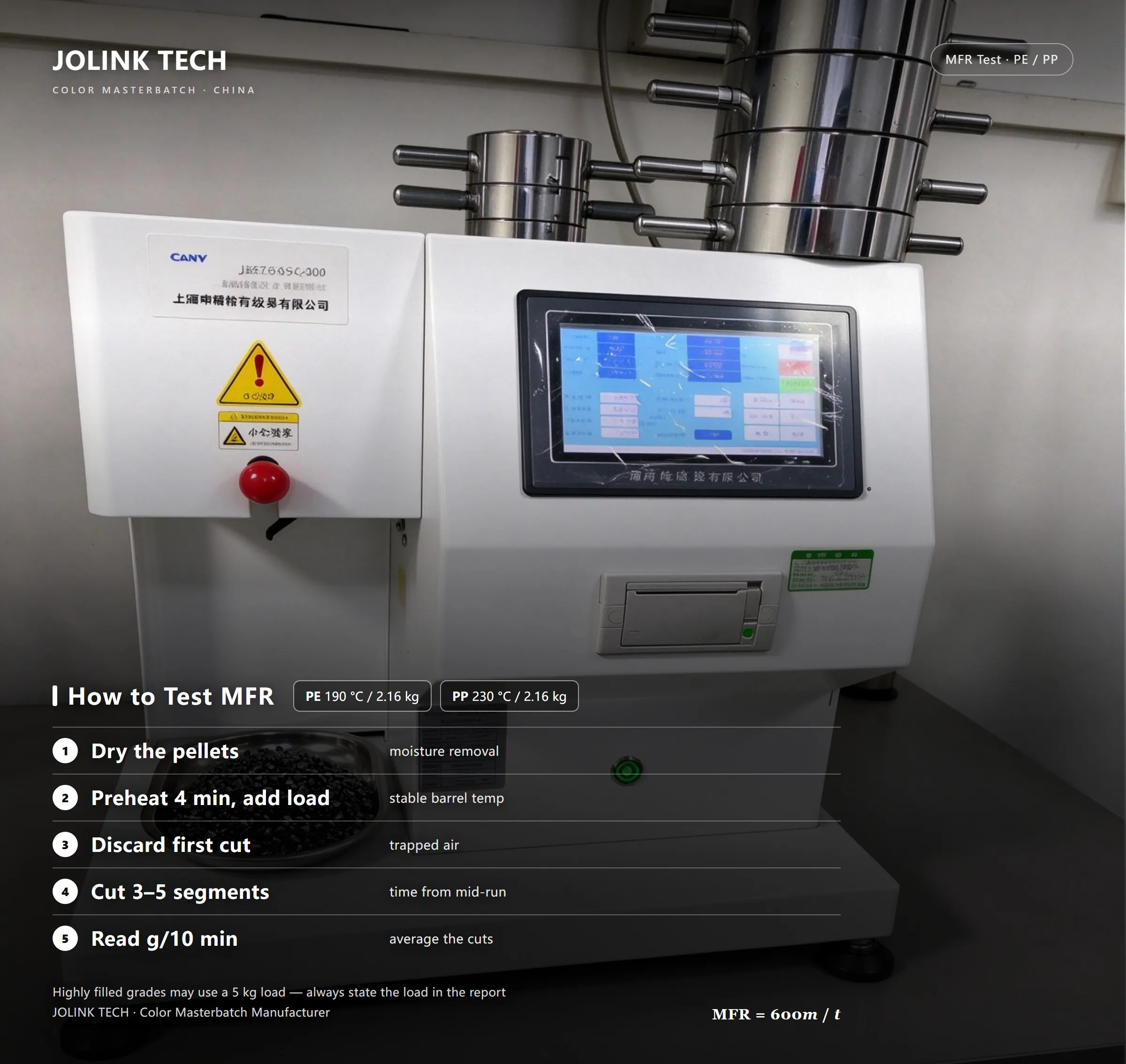
(一)How it's measured
MFI — melt mass-flow rate (MFR), expressed in g/10 min — answers one question: how many grams of melt pass through a standard die (Ø2.095 mm × 8 mm) in ten minutes at a fixed temperature and load.
We follow ISO 1133-1 / ASTM D1238 at the carrier's own condition: 190 °C/2.16 kg for PE masterbatch, 230 °C/2.16 kg for PP. Heavily filled grades may be run at 5 kg, but the condition is always stated on the report. Samples are dried (mandatory for PET, PA and ABS systems), charged and compacted, preheated for 4 minutes, and the first extrudate — the part carrying air bubbles — is discarded. Three to five cuts are then taken at fixed intervals and weighed. MFR = 600 m/t.
(二)Why it correlates with dispersion
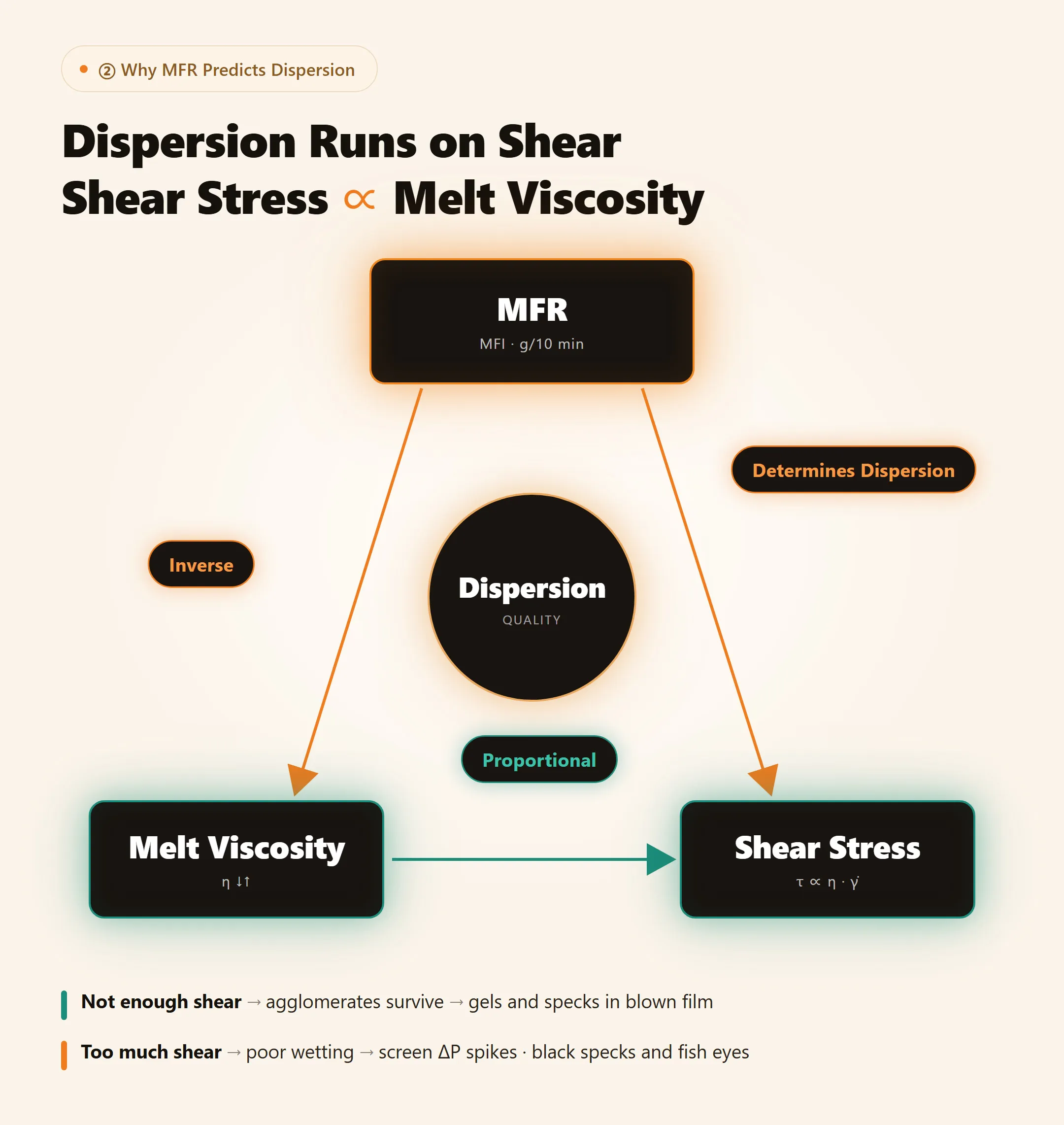
Dispersion is a shear process. Shear stress scales with melt viscosity, and viscosity is the inverse of MFI.
Low MFI means high molecular weight and high viscosity: strong stress on TiO₂ and carbon black agglomerates inside the twin-screw, so clusters break apart. Push it too far, though, and wetting suffers, screen-pack pressure spikes, and you get gels, specks and fisheyes.
High MFI is the mirror image — fast wetting and easy flow, but not enough stress. Agglomerates survive intact and show up as pinholes in blown film.
MFI is therefore not a number to maximise or minimise. It is a process window. It tells you whether the carrier's molecular weight sits inside that window, whether the lot is consistent, and whether the compound has degraded (MFI drifting up = chain scission) or crosslinked or been contaminated (MFI dropping). When MFI drifts on a fixed formulation, dispersion almost always drifts with it.
(三)One caveat
MFI is a health check, not a dispersion reading. In highly filled masterbatch the value is composite and only comparable within the same formulation. Final dispersion is confirmed by filter pressure value (FPV), particle counts on blown film or pressed plaque, and colour strength.
|
MFI tells you the melt can be sheared consistently. Dispersion tells you it was sheared enough. You need both. |
(一)How it's measured
MFI — melt mass-flow rate (MFR), expressed in g/10 min — answers one question: how many grams of melt pass through a standard die (Ø2.095 mm × 8 mm) in ten minutes at a fixed temperature and load.
We follow ISO 1133-1 / ASTM D1238 at the carrier's own condition: 190 °C/2.16 kg for PE masterbatch, 230 °C/2.16 kg for PP. Heavily filled grades may be run at 5 kg, but the condition is always stated on the report. Samples are dried (mandatory for PET, PA and ABS systems), charged and compacted, preheated for 4 minutes, and the first extrudate — the part carrying air bubbles — is discarded. Three to five cuts are then taken at fixed intervals and weighed. MFR = 600 m/t.
(二)Why it correlates with dispersion
Dispersion is a shear process. Shear stress scales with melt viscosity, and viscosity is the inverse of MFI.
Low MFI means high molecular weight and high viscosity: strong stress on TiO₂ and carbon black agglomerates inside the twin-screw, so clusters break apart. Push it too far, though, and wetting suffers, screen-pack pressure spikes, and you get gels, specks and fisheyes.
High MFI is the mirror image — fast wetting and easy flow, but not enough stress. Agglomerates survive intact and show up as pinholes in blown film.
MFI is therefore not a number to maximise or minimise. It is a process window. It tells you whether the carrier's molecular weight sits inside that window, whether the lot is consistent, and whether the compound has degraded (MFI drifting up = chain scission) or crosslinked or been contaminated (MFI dropping). When MFI drifts on a fixed formulation, dispersion almost always drifts with it
(三)One caveat
MFI is a health check, not a dispersion reading. In highly filled masterbatch the value is composite and only comparable within the same formulation. Final dispersion is confirmed by filter pressure value (FPV), particle counts on blown film or pressed plaque, and colour strength.
|
MFI tells you the melt can be sheared consistently. Dispersion tells you it was sheared enough. You need both. |
Previous: No more data

Contact Us
Tel: +86 757 8118 6668/+86 139 2320 6383
Sales Hotline: +86 139 2320 6383
Address: No. 55, Yong'an Avenue, Guanyao, Shishan Town, Nanhai District, Foshan City, Guangdong Province, China.
Inquire
Copyright © 2026 Guangdong Jolink Technology Co., Ltd.